
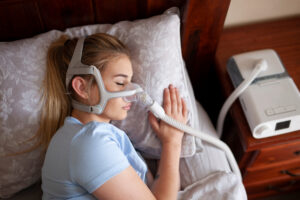
Positive airway pressure therapies play an important role in supporting patients with breathing disorders. Two of the most commonly used therapies are CPAP (Continuous Positive Airway Pressure) and BiPAP (Bilevel Positive Airway Pressure).
While both therapies deliver pressurized air through a mask to help patients breathe more effectively, they are designed to address different respiratory needs. Knowing the difference between CPAP and BiPAP helps families and care teams choose the breathing support that keeps a child comfortable and breathing safely.
What Is CPAP Therapy?
CPAP delivers one steady pressure to help keep the airway open
This steady airflow helps prevent airway collapse during sleep, which is why CPAP is most commonly prescribed for obstructive sleep apnea (OSA). By maintaining consistent pressure throughout the breathing cycle, CPAP helps stabilize airflow and reduce interruptions in breathing.
CPAP therapy is often recommended when:
- Airway obstruction ( A blockage of airflow to your lungs, making it difficult to breathe) occurs during sleep
- Sleep apnea (a condition that makes you stop breathing while you’re sleeping) causes repeated breathing interruptions
- Obesity (overweight)
For many patients, CPAP becomes a consistent part of nighttime respiratory care and significantly improves sleep quality.
What Is BiPAP Therapy?
BiPAP provides two different pressures—one for breathing in and a lower one for breathing out—to make breathing easier.
- Higher pressure during inhalation (IPAP) helps the patient take a deeper breath
- Lower pressure during exhalation (EPAP) makes breathing out easier
These two pressures can reduce the effort required to breathe, making BiPAP particularly helpful for patients whose respiratory muscles need additional support.
BiPAP therapy may be recommended for patients with:
- Neuromuscular conditions that affect breathing (spinal muscular atrophy (SMA), muscular dystrophy, and certain congenital myopathies)
- Chronic respiratory failure
- Central sleep apnea (the brain doesn’t consistently send signals to breathe, so breathing pauses happen even though the airway is open)
- Obesity hypoventilation syndrome
- Certain chronic lung diseases
Because BiPAP assists both inhalation and exhalation, it can provide more comprehensive breathing support for patients with complex respiratory conditions.
CPAP vs BiPAP: Key Differences
- CPAP helps keep the airway open using steady airflow.
- BiPAP helps more by giving extra support when breathing in and easing pressure when breathing out, which is often better for weak muscles.
In simple terms: CPAP keeps the airway open, while BiPAP helps do some of the breathing work when muscles are too weak.
Choosing the Right Therapy
The decision to prescribe CPAP or BiPAP depends on a patient’s diagnosis, respiratory function, and overall care plan.
Physicians may consider factors such as:
- Sleep study results
- Oxygen and carbon dioxide levels
- Respiratory muscle strength
- Underlying neurological or pulmonary conditions
Once therapy is prescribed, proper mask fitting, equipment setup, and patient education play a critical role in ensuring successful treatment.
Supporting Patients as They Begin Therapy
Starting CPAP or BiPAP therapy can feel like a major adjustment for patients and caregivers. Clear guidance and support help patients become more comfortable incorporating respiratory therapy into their routines.
Successful therapy often depends on:
- Proper mask fit and comfort
- Clear instructions for equipment use
- Routine equipment maintenance
- Access to support if adjustments are needed
When patients, families, and caregivers feel confident using their equipment, they are more likely to remain consistent with therapy and experience its full benefits.
Supporting Respiratory Care Beyond the Hospital
Positive airway pressure therapies are an important part of long-term respiratory management for many patients. Ensuring that equipment is properly configured and that patients understand how to use it can help protect respiratory stability once they return home.
At Wave Healthcare and Sail Healthcare, respiratory care is the focus of what we do. Wave supports pediatric respiratory and enteral care, while Sail focuses on adult respiratory services. Together, our teams work alongside clinicians and caregivers to help ensure respiratory equipment is properly set up and that care plans continue smoothly beyond the hospital.Learn more about how Wave and Sail support respiratory care at home